Buying
NC Mortgages Compared: Primary Home vs Investment vs Second Home
Apr 23, 2026 · 7 min
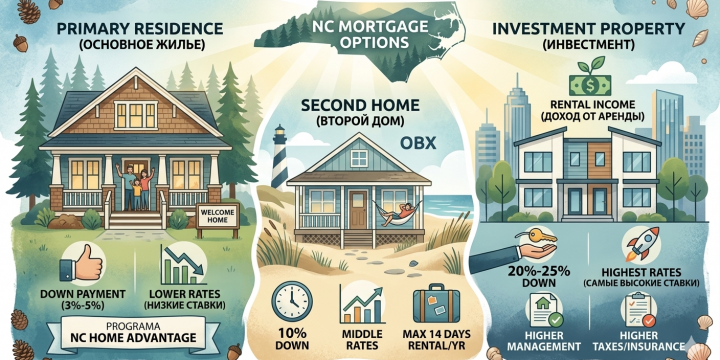
Buying real estate in North Carolina always starts with choosing a mortgage. Mortgages in North Carolina for a primary residence, an investment property and a second home differ sharply in rates, down payment and tax benefits. An error in this category can cost tens of thousands of dollars, so let’s examine the differences in detail.
1. Primary Residence
This is the home where you intend to live most of the year. In North Carolina, the most favorable terms are set aside for these buyers.
Features and advantages:
- Lowest minimum down payment: You can use FHA programs (from 3.5%) or conventional loans with as little as 3% down.
- Low interest rates: The best rates are reserved for this category.
- Tax benefits: You may deduct mortgage interest and property taxes from federal taxable income.
- NC Home Advantage programs: The North Carolina Housing Finance Agency (NCHFA) offers down payment assistance for qualified buyers.
Drawbacks:
- Strict occupancy rules: You must move into the home within 60 days of closing and live there at least one year before you can rent it out.
2. Investment Property
Buying a home to rent out, long-term or short-term through Airbnb.
Features and advantages:
- Income generation: Tenants can cover the mortgage payments.
- Tax write-offs: You can deduct repairs, property management, insurance and depreciation.
Drawbacks:
- High down payment: Expect to put down at least 15–25%.
- Higher rates: The interest rate is usually 0.5–1% higher than for a primary residence.
- Cash reserves: Lenders often require reserves in your account, typically the equivalent of six months of payments.
3. Second Home / Vacation Residence
Property you use for your own vacations, such as a mountain home near Asheville, but do not live in year-round.
Features and advantages:
- Lower rates than investment property: Second-home rates usually sit closer to primary-residence rates than to investment rates.
- Personal enjoyment: You always have a getaway in the best NC locations.
Drawbacks:
- Location criteria: The home must be a certain distance from your primary residence, usually more than 50 miles, or be in a resort area.
- Rental restrictions: You cannot buy this home with the sole purpose of renting it out. If the lender finds out it is really an investment dressed up as a second home, it can be treated as mortgage fraud.
- Down payment: Usually around 10% or more.
Comparison Table (NC Market)
| Feature | Primary Home | Second Home | Investment |
| Min. down payment | 3% – 5% | 10% | 15% – 25% |
| Interest rate | Lowest | Medium | Highest |
| Credit score requirements | Flexible (from 580 for FHA) | Strict (usually 680+) | Strictest (720+) |
| Tax deductions | Yes (mortgage interest) | Yes (with limits) | Yes (business expenses) |
Why this matters for North Carolina residents
When choosing a mortgage in North Carolina, keep in mind that lenders assess each property type differently. And in cities like Apex or Cary, property taxes and insurance premiums can vary considerably. For an investment property in NC, insurance costs more than for an owner-occupied home, because the risks of rental tenants are rated higher.
Conclusion
Choosing the right mortgage type saves you tens of thousands of dollars over the long run. If you plan to buy in the Triangle or on the coast, be sure to consult a local broker who understands the specifics of NC taxes. A mortgage in North Carolina is not one product but three different ones, and the right choice depends on your goal. Official mortgage guidance is available at CFPB. If you are a first-time buyer, read that guide too.
Questions & answers
What down payment does an investment property need in NC?
Typically 15-25% for investment loans versus 3-5% for many primary-residence programs, with higher rates and six months of reserves commonly required. Your lender confirms exact terms.
How is a second home loan different?
Second homes sit between primary and investment rules: higher down payment than primary, occupancy requirements, and limits on renting it out. Misclassifying occupancy is mortgage fraud - get it in writing.
Can I use rental income to qualify?
Sometimes: lenders may count a portion of projected rent with a signed lease or appraisal rent schedule, minus vacancy factors. Investment qualification is stricter - expect full documentation.