Relocation
Wake County Growth Statistics (Raleigh and Suburbs)
Feb 7, 2019 · 4 min
Recently I attended a presentation by Terry Nolan of the Wake County Planning and Development Department. Here are several data points on Wake County growth, plus some related infographics:
- Wake County’s population exceeds 1 million, and growth is 2.4 times faster than the state as a whole from 2010 through 2017.
- Wake County grows by 63 people per day: 43 new arrivals and 20 from “natural increase” (births minus deaths).
- On average about 2,800 acres (1,133 hectares) are developed for construction each year - half the area of Umstead State Park, for comparison.
- 53% of Wake County residents hold at least a bachelor’s degree.
- Median income in Wake County rose 16% from 2006 to 2016, to $76,100 - above the statewide $50,584 in 2016 (which grew 10% over the same period).
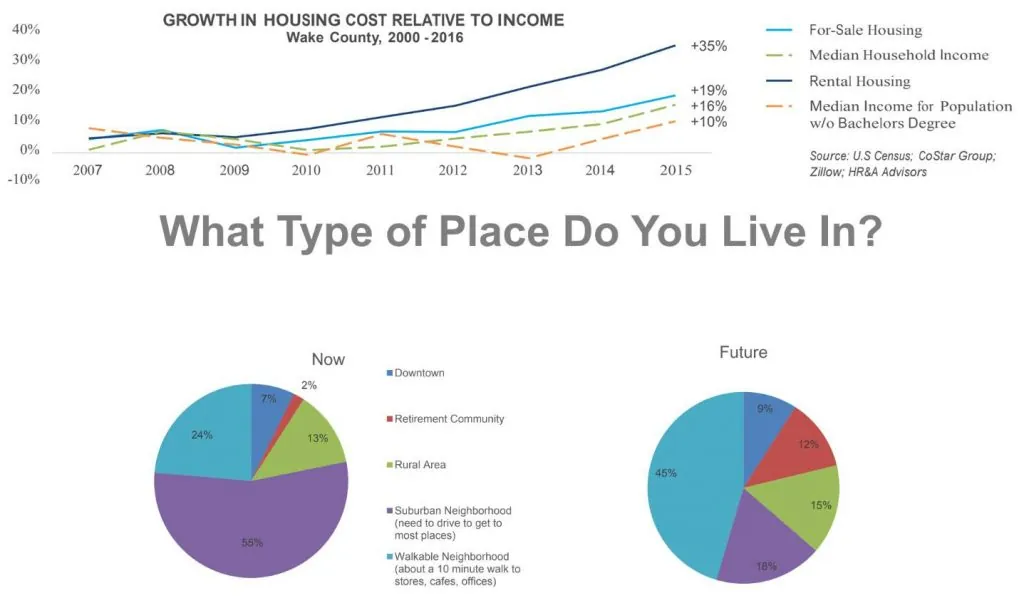
- Since 2006, median income for residents without a bachelor’s degree rose 10%, while rents rose 35%.
- About 450,000 people commute by car, averaging 25 minutes one way. The number working from home is up 10% since 2010.
- By 2040, forecasters expect major roads and highways to exceed their designed traffic capacity.
- In 2016 Wake County raised the sales tax by half a cent and plans to invest $2.3 billion over ten years in further public transit, with a target of transit reaching 70% of jobs and 50% of homes.
- Public transit ridership grew 6.6% from 2017 to 2018.
- A population survey (see the pie chart) shows more people want to live in subdivisions and apartments near restaurants, shops and offices - within walking distance rather than a drive.
- As the chart shows, rents rose 35% while home prices rose 19% and median household income grew 16%.
Questions & answers
How fast is Wake County growing?
Above one million residents, growing about 2.4 times faster than the state, plus roughly 63 new people a day. Growth concentrates along RTP corridors and western suburbs.
What drives Triangle growth?
Tech and life-science employers around RTP and RDU, top universities, relative affordability versus coastal metros, and top-rated schools pulling relocating families.
Will growth keep home prices up?
Demand supports prices long-term, but supply responds: corridors with heavy new construction appreciate slower than constrained infill zones. Buy submarket by submarket.